High surf and coastal flood warnings take effect Wednesday for SLO County beaches
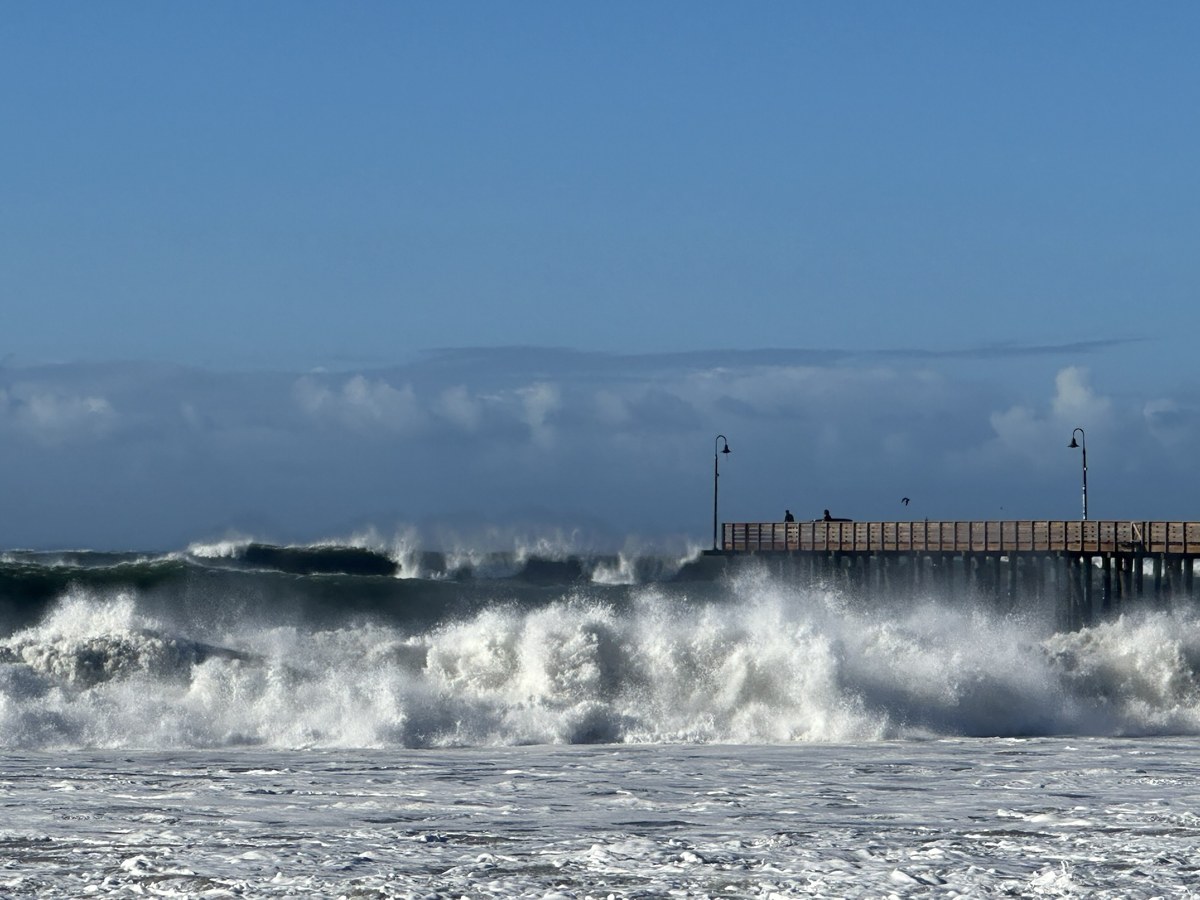
Large waves break near the Cayucos Pier on Nov. 14, 2026. Photo by Ilse Talke, courtesy of Cal Poly.
Waves of 15 to 22 feet expected Wednesday and Thursday on SLO County beaches
– The National Weather Service has issued a high surf warning and a coastal flood warning for San Luis Obispo County beaches, including the North Coast communities of Morro Bay and Cayucos, from 6 a.m. Wednesday, Nov. 25, to noon Thursday, Nov. 26.
The high surf warning calls for large, damaging breaking waves of 15 to 22 feet with dangerous rip currents. The coastal flood warning means significant coastal flooding is expected. Until 6 a.m. Wednesday, a high surf advisory for breaking waves of 8 to 12 feet and a coastal flood advisory for minor to moderate flooding remain in effect.
Extremely high tides of 7.7 to 8.2 feet will likely peak between 7 and 11 a.m., according to the weather service. Damaging flooding of sea water is likely over some vulnerable low-lying coastal areas, especially around the time of high tide, including beaches, roads and structures. The weather service said the areas most at risk include Oceano Dunes, Pismo Beach, Morro Bay and Guadalupe Dunes, and significant beach erosion is expected.
Powerful waves and strong rip currents pose an exceptional risk of ocean drowning and damage to coastal structures such as piers, including those in Cayucos, Avila and Pismo, and jetties. Large breaking waves may reach Morro Bay Harbor, and extremely high tides may damage docks and send seawater over low-lying areas inside harbor areas.
The weather service urges people to stay off beaches, coastal walkways, roads, jetties, piers and other waterside structures, to stay out of the water, and not to drive around barricades or through water of unknown depth. Advisories are likely to follow the expiration of the warnings.
Paso Robles Daily News previously reported on high surf that ripped pilings from one county pier and closed another.
Cal Poly study points to possible record-high water levels
The warnings come as new research led by a Cal Poly engineering professor finds that unusually high tides coinciding with a powerful El Niño could push coastal water levels to record highs in much of California this winter.
At Port San Luis, a predicted astronomical tide of 6.9 feet on Wednesday, Nov. 25, could result in water levels reaching approximately 8 feet if unusually elevated ocean levels persist, according to the study. The station’s non-tsunami record of 8.03 feet was set Jan. 27, 1983, during the destructive 1982-83 El Niño.
The study, “How Astronomical Cycles Can Exacerbate El Niño Impacts,” has been accepted for publication in Geophysical Research Letters. It finds that natural cycles in the moon’s orbit are amplifying tides just as El Niño is raising ocean levels, and that these forces, together with decades of sea-level rise, could produce record-high water levels and more frequent, longer-lasting high-water events.
“It’s astonishing that we broke records at four locations in October,” said Stefan Talke, a professor in Cal Poly’s Civil and Environmental Engineering Department. Predicted tides are slightly higher this year than in 1982-83, Talke said, and sea levels along the Central Coast have risen since then. “So, in terms of risk factors, we are in new territory,” he said.
Talke urged coastal residents to pay attention to high-tide forecasts, particularly around Nov. 24 and Dec. 24, when some of the season’s highest astronomical tides are expected. He advised people to avoid beaches and other low-lying coastal areas during high tides accompanied by large waves and to use caution near bluffs, where rain and wave action can increase the risk of collapse.
Talke and his fellow researchers analyzed decades of measurements from 23 tide stations along the West Coast. The study was co-authored by researchers at Pacific Northwest National Laboratory, the Gulf of Maine Research Institute and the Technical University of Munich.
For more information, visit Cal Poly’s El Niño experts guide.